Every piece of data you store has a purpose. Over time, as employees, customers and projects come and go, your organization will likely accumulate hard drives full of private data it no longer needs. Storing old drives takes up space and creates risk. What you need is a secure data destruction method that permanently eliminates that information without opening the door to privacy breaches.
Most organizations choose one of two methods for disposing of hard drives: hard drive shredding or degaussing. Both can destroy data effectively, but they differ in which devices they work on, how destruction is verified and how well they support compliance. Explore both methods with NAID AAA Certified TrueShred to find the right data destruction method for your organization.
Hard Drive Shredding vs. Degaussing at a Glance
| Hard Drive Shredding | Degaussing | |
|---|---|---|
| How it works | Physically destroys the drive into small fragments | Erases data with a powerful magnetic field |
| Works on HDDs | Yes | Yes |
| Works on SSDs, USB drives and flash media | Yes | No |
| Visible proof of destruction | Yes, the drive is destroyed | No, the drive looks intact |
| Best for | All media types and strict compliance requirements | Magnetic media only |
Hard Drive Shredding
When you dispose of important paperwork, you shred it to protect the information. Hard drive shredding works the same way, using a much larger and more rugged industrial shredder built to cut through metal casings, platters and circuit boards.
Shredding is an excellent choice for both hard disk drives (HDDs) and solid-state drives (SSDs). When shredding SSDs, make sure your provider can reduce the small memory chips inside the device to fragments, since intact chips may still hold recoverable data.
Key benefits of hard drive shredding include:
- Works on every device: Shredding destroys HDDs, SSDs, USB drives, backup tapes and other electronic media.
- Permanent results: Once a drive is shredded, the data cannot be recovered.
- Visible verification: You can see that the device has been destroyed.
- Compliance documentation: A Certificate of Destruction provides an auditable record for HIPAA, GLBA, FACTA and other regulations.
The Degaussing Process
Degaussing does not physically destroy the hard drive. Instead, the drive is exposed to an extremely powerful magnetic field. Because HDDs store information magnetically, the degausser scrambles the data in seconds and renders the drive unusable. The drive can then be recycled.
While degaussing is fast and convenient, it is not the right choice for every organization:
- Limited to magnetic media: SSDs, USB drives and flash memory do not store data magnetically, so degaussing will not erase them.
- No visible proof: A degaussed drive looks the same as it did before, which can make destruction harder to verify.
- Equipment matters: The degausser must be strong enough for the type of drive being erased.
- Compliance gaps: If your industry requires documentation that a device was destroyed, degaussing alone may not meet that standard.
Comparing the Methods
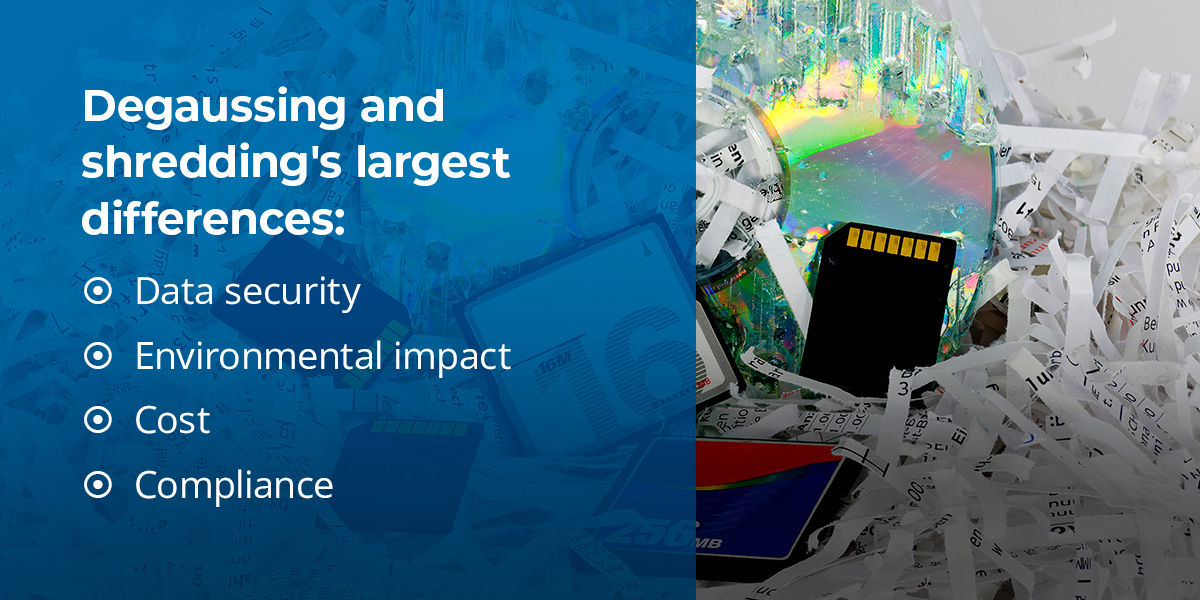
If both methods can eliminate confidential data, how do you choose? Here are the biggest differences between hard drive shredding and degaussing:
- Data security: Shredding destroys information on any device, while degaussing only works on magnetic media.
- Environmental impact: Degaussed drives can be recycled intact. Shredded drives produce mixed materials that are sorted and recycled.
- Cost: Degaussing requires specialized equipment, and many organizations still shred drives after degaussing for added assurance. Shredding handles everything in one step.
- Compliance: When compliance is essential, shredding provides a clear record of physical destruction.
Data Destruction Requirements for DMV Organizations
Organizations across Washington, D.C., Northern Virginia and Maryland often face strict data destruction requirements. The right method depends on your industry:
- Federal agencies and contractors: Government organizations in Northern Virginia and D.C. often follow NIST SP 800-88 guidelines, which recognize physical destruction such as shredding as the highest level of media sanitization.
- Data centers and IT departments: Companies in Loudoun County’s data center corridor, including Ashburn, regularly retire large volumes of HDDs and SSDs that require a method that works on both.
- Healthcare providers: Medical practices in Bethesda and Rockville must protect patient data under HIPAA.
- Financial institutions: Banks and financial firms from Fairfax to Baltimore must safeguard customer information under GLBA.
Choosing the Right Data Destruction Method for Your Needs
The right method depends on your organization’s needs. As you weigh your options, ask yourself:
- Do you need physical evidence of data destruction to ensure compliance?
- Is sustainability an important part of your business practices?
- What is your organization’s risk tolerance?
- Do you need to dispose of SSDs, USB drives or other devices that do not store data magnetically?
- How flexible is your budget?
- How confidential is the data you’re destroying?
If you answered yes to needing physical proof or destroying non-magnetic media, hard drive shredding is likely the better choice.
Hard Drive Shredding vs. Degaussing FAQs
Does degaussing work on SSDs?
No. Solid-state drives store data on flash memory chips, not magnetic platters, so degaussing will not erase them. SSDs should be physically shredded to ensure the memory chips are destroyed.
Is degaussing enough to destroy data on a hard drive?
Degaussing can erase data on traditional magnetic hard drives when the degausser is strong enough for the drive. However, because the drive remains physically intact, many organizations shred drives after degaussing for added assurance.
Can data be recovered from a shredded hard drive?
No. Industrial hard drive shredding reduces platters, chips and circuit boards to small fragments, making data recovery practically impossible.
Is wiping or reformatting a hard drive enough?
Reformatting does not permanently remove data, and software wiping can be unreliable, especially on SSDs. Physical destruction is the most secure way to ensure data cannot be recovered.
Does NIST 800-88 require hard drive shredding?
NIST SP 800-88 outlines three levels of media sanitization: clear, purge and destroy. Shredding falls under destroy, the highest level, and is often required for highly sensitive government and contractor data.
Do I receive proof that my hard drives were destroyed?
Yes. TrueShred provides a Certificate of Destruction after service, giving your organization an auditable record of secure data destruction.
Protect Your Privacy With Secure Data Destruction Services
Whether you prefer hard drive shredding or degaussing, TrueShred’s professionals can help. Regardless of your organization’s size or the amount of data you need to destroy, we will recommend the right method for your electronics and paper files and ensure security from start to finish.
From our secure facility in Manassas, we serve organizations throughout Washington, D.C., Fairfax, Arlington, Bethesda and Baltimore, with both on-site and off-site destruction services.
Consult with our data protection experts or request a free quote today.